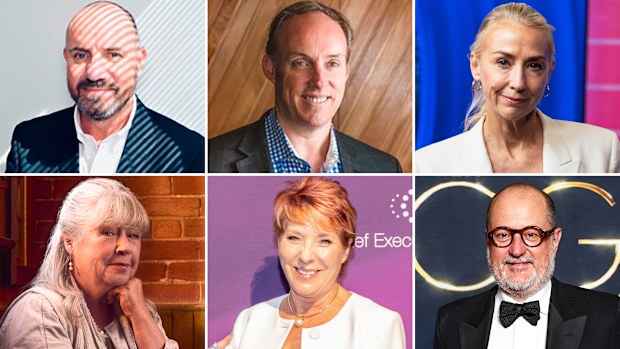
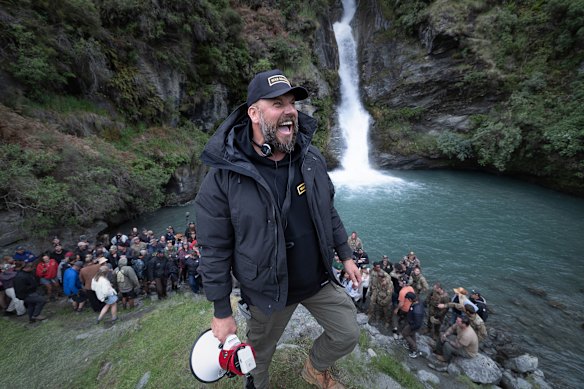
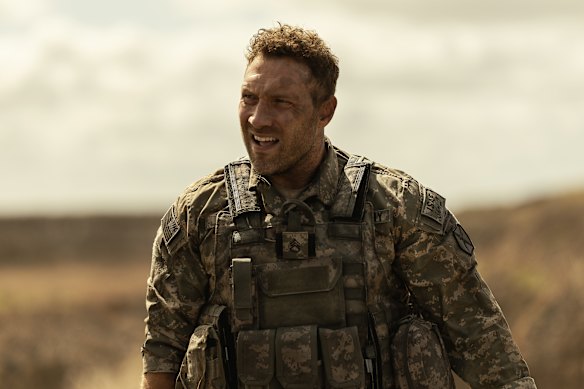
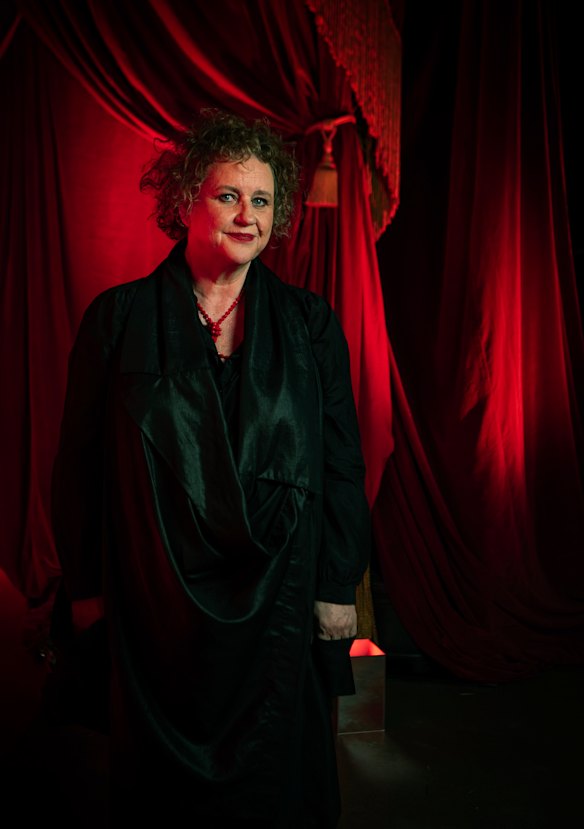
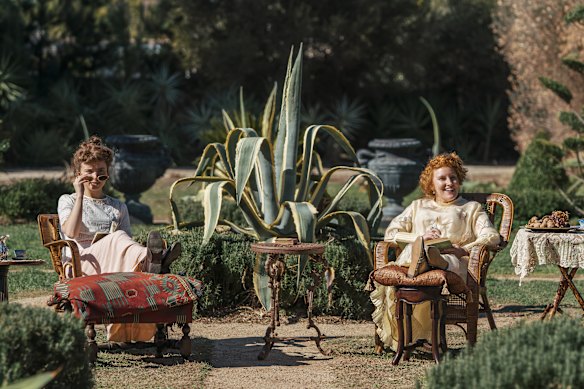
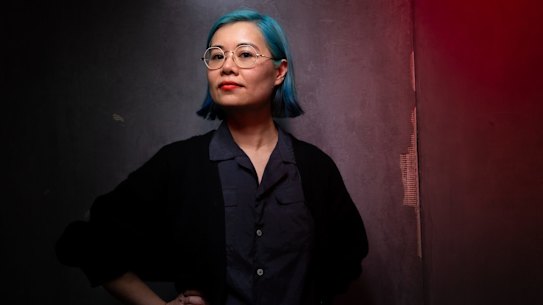
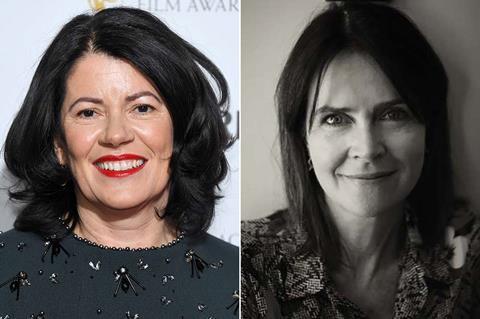
IF Rising Talent 2026 Directors. Top row (L-R): Emma Hough Hobbs, Leela Varghese (Photo: Kyahm Ross), Nina Buxton. Bottom row: Lucy Knox, Harry Lloyd (Photo: @lesjouesrouges), Constantine Costi.
The final category for IF Rising Talent 2026 is directors.
The list spotlights the next wave of creatives driving the local screen industry forward. They’re people with significant career momentum who we think you’ll be hearing a lot more about.
We assemble the list through a public call out, extensive industry outreach and our own editorial research, with more than 580 names put forward in total this year across all 12 categories, including more than 140 directors alone.
We know the list only scratches the surface of the remarkable talent working across Australia.
Varghese’s short film I’m the Most Racist Person I Know premiered in the Narrative Short Competition at SXSW Austin 2025, where it won the Special Jury Award and was selected for the Redbreast Unhidden campaign curated by actor Andrew Scott. It won Best Short Film at the 2026 AACTA Awards.
Hobb’s short, the inaugural Hanlon Larsen Fellowship film On Film, was In Competition at SXSW Sydney 2023 and won Best Animation at the South Australian Screen Awards.
Harry Lloyd
(Photo: @lesjouesrouges)
Harry Lloyd is a writer and director drawn to stories that explore identity, power, class and belonging, moving between drama, comedy and horror.
Lloyd was set-up director on SBS Digital Original series Homebodies, directing five of the six episodes. The series premiered in competition at Series Mania 2026, where it received a Special Mention and was named a “Global Breakout” by Deadline. Lloyd directed nearly 50 episodes of Fremantle’s Neighbours for Amazon Studios, with other credits including Nickelodeon’s Rock Island Mysteries, ABC’s Turn Up the Volume and TikTok vertical series CEEBS. They were a VicScreen director’s attachment on Apple Cider Vinegar with Jeffrey Walker, and directed the short film Dog Eats World, written by and starring Chika Ikogwe, which premiered at Flickerfest.
A proud trans-masc creator originally from South-West Wales, Lloyd is currently developing folk horror feature Mari Lwyd as an Australia/Wales co-production, alongside a slate spanning revenge thriller, sports drama and social satire. They won the NYC Screenwriting Challenge for short comedy and have written for ABC’s Mikki vs the World and 10’s The Project.
Constantine Costi
Constantine Costi is a Greek Cypriot-Australian director and writer working across film, opera and theatre.
His documentary following the World Porridge Making Championship, The Golden Spurtle, made its world premiere at CPH:DOX in the Next Wave competition for innovative films by emerging artists and filmmakers. It went on to screen at other international festivals including Telluride Film Festival, Energa Camerimage Festival and Zurich Film Festival, as well as Melbourne International Film Festival and Sydney Film Festival. The Golden Spurtle was awarded Best Documentary by the Australian Film Critics Association and was Letterboxd’s seventh highest rated documentary of the year worldwide in 2025.
In 2020, Costi released his first screen project, the 60-minute film A Delicate Fire for Pinchgut Opera, based on the madrigals of Barbara Strozzi. It was awarded Best Australian Feature at the Sydney Women’s Film Festival, and the ATOM Award’s Best Experimental Film.
Costi served as co-artistic director of Red Line Productions at the Old Fitz Theatre from 2020–2023. In 2026, he will direct a new production of Puccini’s La Bohème for Opera Australia and Hänsel Und Gretel + Into The Woods for State Opera of South Australia. Other recent credits include Abduction (Victorian Opera) and Sydney Festival’s Siegfried and Roy: The Unauthorised Opera.
He is currently writing his next film, a feature-length musical based on a French novella, to be produced by Film Depot.
Nina Buxton
Nina Buxton has just completed directing all six episodes of the upcoming ABC series Separated at Birth. Her other recent credits include episodes of Netflix’s Heartbreak High season three and ABC’s Dog Park.
A graduate of the Victorian College of the Arts, Buxton is drawn to suspenseful, character-led stories with a strong female perspective.
Her short films have screened at festivals around the world including Melbourne International Film Festival, Palm Springs, Munich Film Festival and New Orleans Film Festival. Her most recent short, Bubba, premiered on opening night of Rooftop Films New York in 2025.
Buxton’s other television directing credits include The InBestigators (Netflix), Summer Love (ABC), Paper Dolls (Paramount +) and Planet Lulin (ABC), for which she was nominated for an Australian Directors Guild Award in 2024. She was also selected as director’s attachment to Jocelyn Moorhouse on Netflix’s Boy Swallows Universe.
Lucy Knox
Lucy Knox’s debut feature Hot Mother is in development, to be produced by Carver Films, Toni Collette and Oscar-winning producer of Anora, Alex Coco, with Collette and Milly Alcock attached to star.
The film is based on Knox’s 2020 short by the same name which premiered at Berlinale. It saw her nominated for an Australian Directors’ Guild (ADG) Award and was later acquired by The Criterion Channel.
Knox is a 2025 Torino Film Lab Fellow and was selected for the inaugural Square Peg Social program, led by Ari Aster and Lars Knudsen.
Her earlier short An Act of Love premiered at Sydney, receiving a Special Mention for Best Short Screenplay, and went on to win Best Direction in a Student Film at the ADG Awards and the Mona Brand Emerging Writer’s Award. In 2018, her short documentary Last Man Standing screened at Sheffield DocFest and the Museum of Modern Art in New York and was a Tropfest finalist.
In 2022, she undertook a director’s placement shadowing director Michael Gracey on Better Man. She has also produced projects, including Burlesque Boys, which won Vice and Screen Australia’s Pitch Australiana comp in 2019.
Alongside her narrative work, she directs commercial projects for clients including Google, NRMA and the Australian Government, with work recognised at Ciclope and the 1.4 Awards.
She is currently developing a slate of original film and television projects.
Rising Talent is one of IF’s biggest editorial initiatives each year. If you value the work behind it, the best way to support us is by subscribing.
The purported redundancy of the man who once invented a new award to avoid embarrassing Robert De Niro has left many hoping for a fresh start. Except he’s refusing to go.
AACTA CEO Damian Trewhella has reportedly not resigned or been stood down. Getty
When Robert De Niro arrived at the 2nd AACTA International Awards in 2013 expecting an award for his performance in Silver Linings Playbook, there was a problem.
The Australian Academy of Cinema and Television Arts didn’t have an award for him. After producer Harvey Weinstein made his displeasure felt, AACTA CEO Damian Trewhella created a new supporting actor award on the spot. There were two spare trophies so it was hurriedly decided that De Niro’s co-star Jacki Weaver could win the until-then non-existent gong for supporting actress. AACTA later described these as “discretionary awards”.
While no one was hurt and time makes the incident comical rather than consequential, it was symptomatic of what became ongoing missteps by the organisation that describes itself as “Australia’s most prestigious film and television membership body”. It also helps explain why the film and television sector has long harboured concerns about AACTA, whose long-serving CEO was abruptly made redundant this month.
Many in the industry AACTA claims to represent believe its authority had faded, citing poor management and governance and say the awards themselves have been devalued.
Documentary filmmaker Simon Nasht says there are “industry concerns about the way AACTA conducts itself” because the awards process is “ridiculously expensive, lacks transparency and the exclusion of many craft awards really rankled.
“It seemed obsessed with stars while often overlooking the many other professional skills in the industry,” Nasht said. “While improvements were apparent in the past couple of years, the truth is that for many in the industry, AACTA was irrelevant.”
After the De Niro incident, came 2015, when The Water Diviner and The Babadook tied for Best Film. Trewhella described the “mathematical tie” as “just a freakish outcome.” The Sydney Morning Heraldlater reported it wasn’t a tie. The horror film topped the vote – just – but AACTA decided to share the prize. Trewhella’s view was that “as both films were so close to each other in the final standings, the fairest outcome was to award a tie.”
This month, after years of such controversies, the board announced Trewhella’s 18-year reign as boss of AACTA was over.
The low-profile Melburnian oversaw the member-based organisation and the film industry’s major award ceremony the AACTA Awards.
He earns a salary and superannuation package in excess of $350,000 annually as CEO of ‘the Academy’, a not-for-profit body with charitable status that turns over $6.6 million annually, half of which is from government hand-outs. By comparison, Screen Australia CEO Deirdre Brennan earns a base salary of $381,603 for overseeing an agency with more than $100 million income and 55 ongoing employees.
AACTA chair Jack Christian announced last week the CEO’s role had been made redundant in a restructure: “The Board of the Australian Film Institute has recently implemented a revised management structure, and as part of that process, Damian Trewhella has left the role of chief executive officer.”
Christian added the Board has commenced an independent review. Trewhella promptly fired back, stating: “I have not resigned, nor have I agreed to step down.” He said he remained “fully committed to returning to my role as CEO of AFI AACTA and to serving our members and the Australian Film and Television industries.”
AFR Weekend approached both Christian and Trewhella for comment. Neither spoke due to potential legal proceedings,
Trewhella joined AACTA in 2006 when it was known as the Australian Film Institute – the name it still trades under –and his then-mother-in-law Maggie Gerrand was an AFI board member. In 2008, he was surprisingly elevated to general manager.
One constant since the AFI adopted the AACTA name in 2011 has been a rapid and continual turnover of board members, particularly in the last decade.
AACTA directors that have come and gone: (Top row L-R) Alaric McAusland, Mike Baard and Amanda Laing and (bottom row L-R) Noni Hazlehurst, Anita Jacoby and Russel Howcroft.
Among the industry stalwarts to come and go as board directors in the past decade are actor Noni Hazlehurst, reviewing icon Margaret Pomeranz, Universal Pictures International Australia boss Mike Baard, Ausfilm chairman Alaric McAusland, Nine Entertainment’s managing director, streaming and broadcast Amanda Laing, director Nadia Tass, corporate lawyer Jennifer Huby, agent Mark Morrissey, producers Keith Rodger, Darren Dale, Anita Jacoby and Ian Sutherland, Geoff Brown, Foxtel’s Brian Walsh, broadcaster Russel Howcroft and long-time chair and supporter of Trewhella, Alan Finney.
Some left of their own making, including Laing, Baard and Dale, while others, including McAusland and Sutherland, are understood to have felt they were pushed out after two-year terms. The popular Jacoby lost her board role after two years when her position came up for re-election, and after her objection to Trewhella’s handling of former AACTA patron Geoffrey Rush. She lost to Jo Smith, the little-known manager of the out-of-action Regal Cinema in Newcastle. Regarded by her peers as a Trewhella acolyte, Smith also won last year’s member election, surprisingly defeating better-known and more active industry player, Marcus Gillezeau.
The only constant in board meetings for two decades has been Trewhella. The CEO is not a board position, but does oversee the membership and members votes.
The organisation’s governing memorandum of association, last amended in 2007, allows for rapid turnover of directors. The MOA is so outdated, it still only refers to its duties involving ‘film’ and makes no mention of digital services, streaming or even television.
Since the November 2023 AGM, eight members – Finney, Tass, Laing, Dale, Rodger, Smith and Huby – have left the board, which now only has the minimum three members: Christian, actor Shane Jacobson and long-time AFI legal consultant Tony Petani.
At least two members must be elected by an ordinary resolution of the members of the institute, although it is not clear who they are.
In 2019, the members’ vote for new directors was overseen by Philip Dowsley, a former auditor deregistered by ASIC. He was investigated by ASIC in 2012 and three years later found to be not a fit and proper person to remain registered.
“If you started to question things, suddenly you’re persona non grata,” said a director who says he was moved on after requesting transparency.
The veracity of AACTA’s awards system has also often been questioned. While some of the criticism may be sour grapes, AACTA Award eligibility requirements and entry dates for some films and categories have been changed arbitrarily. Staff and vendors also note AACTA’s desire to attract the highest-profile stars of the moment to their ceremony each year; coincidentally, winning awards might encourage their attendance (last year, it was Margot Robbie; this year Jacob Elordi, although the Frankenstein star couldn’t attend the February ceremony AACTA’s despite requests. His Academy Award nomination took precedence).
Does it even matter? From the outside, criticism of the awards and the industry group that runs them looks like not-very-serious people arguing about baubles and stage time.
But the AFI/AACTA Awards have been a touchpoint for Australian screen culture to such an extent its high-profile, non-executive group currently includes AACTA president Russell Crowe, vice president Nicole Kidman, patron Dr George Miller and ambassadors Cate Blanchett, Baz Luhrmann and Catherine Martin.
Former chairman Keith Rodger, who asked for a review, and ACCTA president Russell Crowe at a film premier event in 2022. WireImage
Crowe, particularly, has devoted much effort in the past two decades to resuscitate the awards. He and others appreciate the awards’ lineage, profile and its role in boosting the nascent Australian film industry of the 1970s. You can’t argue with a legacy of directing winners including Peter Weir, Fred Schepisi, Baz Luhrmann,Jane Campion to Jennifer Kent and Warwick Thornton.
Oddly, respect for the AFI/AACTA legacy has undermined its current status. Board directors are unwilling to make their concerns public because it would destabilise an organisation they value and reflect poorly upon non-executive stars such as Kidman and Blanchett who provide their time and power. However, AFR Weekend spoke to more than five directors who said they were concerned about management accountability and related governance issues.
Until 2023, the CEO chaired board meetings and acted as secretary, also writing the minutes. Questions or complaints raised in board meetings were not minuted. AACTA does not have a risk and audit committee, nor does it file directors’ reports. AACTA’s accounts have been passed between four different auditors in the past eight years and the annual financial reports have been filed late to the Australian Charities and Not-for-profits Commission – most recently the 2022-23 financial report.
One board member suggested Trewhella ran the organisation as a “sole trader”. The AFI corporate credit card is in his name although AFR Weekend does not suggest impropriety with its use.
The question is why has the AACTA chair decided now is the time for a restructure? And why haven’t the successive state and federal government agencies propping up Trewhella and AACTA ever called for accountability?
Partly, that’s because it is essentially an organisation that runs a single event which is funded by whichever state is in need of column inches, airtime and social media cred. This year, Queensland Minister for Tourism Andrew Powell said the AACTA Awards and Festival generated “an estimated $4.85 million for Queensland’s economy.” He didn’t show his calculations.
The Queensland government and Screen Queensland, as part of its 10-year arts and cultural strategy Queensland’s Time to Shine, are believed to be investing up to $3 million annually to host the AACTA Awards on the Gold Coast until 2028 (although it could go beyond then ; the 2025 AACTA financial report states revenue from government and other grants is $2.689 million, while sponsorship comprised $3.077 million).
Essentially, AACTA is funded to run a high-profile party each year while industry guilds, Australians In Film, Screen Producers Australia and state screen agencies promote screen culture, lobby government, develop policy, and market the industry.
Federal agency Screen Australia has wound back its hand-outs to AACTA over time and its current annual $366,000 distribution barely covers the CEO’s package.
AACTA directorships are unpaid and some departures were attributed to the volunteer role not being worth the reputational damage, says one former director who saw their future board prospects being compromised.
“When one feels one can’t get answers from the CEO or fulfil their fiduciary duties, you have to get out of there,” another said.
“We don’t get the salary, we don’t get the perks, we don’t get the credit card to push things through,” said another. “We do it because we’re passionate and want the best for the industry.”
Board requests for strategic reviews in 2017 and 2021 were kicked down the road. Key decisions were not escalated to the board. Directors suggest the CEO and long-term chair Finney had a fundamental misunderstanding of how management and boards operate. Finney served as chair from 2010-2022 and remained on the board until 2024
Board schisms were ongoing. Previous acting chair Keith Rodger was sidelined in November 2023 after he asked for a full review of the organisation’s business, primarily to establish more efficient practices.
Speaking on background, directors cited Trewhella’s lack of accountability on his salary, which had no KPIs attached, let alone a remuneration and benefits process to fulfil. Frequent international travel to Los Angeles, the Cannes Film Festival, Shanghai and beyond went unreported and the CEO would be unavailable to the board.
This week, Trewhella engaged a public relations agency and lawyers who expect to file a wrongful dismissal case in Fair Work Australia next week and have sent a letter to publications putting them on notice of potential defamatory publication.
The CEO will fight for his position to be reinstated. He declined to comment for this article, citing ongoing legal discussions. He is said to have been “blindsided” by his redundancy.
Beyond governance issues, he’s overseen a litany of embarrassing controversies, including developing the short-lived and very expensive AACTA International Awards ceremony in Los Angeles and Asia International Engagement Program, and failing to revoke its inaugural AACTA International Fellowship – another discretionary award – given to sexual predator Weinstein.
In 2017, the board split following the panicked dismissal and Trewhella’s subsequent fawning apology to AACTA patron Geoffrey Rush after sexual harassment allegations emerged. Emails submitted in Rush’s high-profile defamation case pointed to a tenuous business model that relied solely on access to talent.
“This organisation exists in a very fragile state that is heavily reliant on the generous support of discretionary partners (primarily tourism/retail) whose only real interest is in connecting with the public via the talent we can access,” Trewhella told the board in one 2017 email.
He spelt out the delicate balance, noting AACTA’s “talent association” was “the only thing we’ve been able to develop a going concern around” but was also a “major jeopardy for our business”.
In 2021, AACTA’s all-white leadership team further ruffled feathers by making it mandatory for award entrants to detail how their films and television programs promote racial, gender, sexual, religious or other forms of diversity, as a condition of entry. Subsequently, respected multi-award winning First Nations producer Darren Dale had a short stint on the board.
Growing industry, staff and vendor dissatisfaction with Trewhella accelerated during the AACTA Awards last month on the Gold Coast. The resignation of AACTA’s operations manager and vendor dissatisfaction gave AACTA chair Christian the chance to move after numerous prior discussions with stakeholders.
Christian would not speak due to the ongoing review and legal challenges. Sources suggest he is embarrassed by the position he’s been placed in after being brought in by Trewhella and then discovering an unpopular and disorganised body.
An overdue restructure will likely feature a new general manager on market rates of $180,000-$220,000 and a raft of new policies. But stability may be some way off if Trewhella doesn’t settle for a redundancy payout (four weeks’ pay for each of 18 years will be approximately $500,000, unless his contract says otherwise).
The only constant is that the AFI/AACTA Awards will continue, at least until Queensland’s funding expires in 2028.
Let me paint you a picture. It’s May 2025. I’m standing in a room in the South of France wearing sequins and what can only be described as a bridal party sash, clutching a microphone, about to pitch a drag queen horror film to some of the world’s most discerning genre enthusiasts. The rosé at the after-party is ice-cold. My hands are not.
And above all else I am stressed because as Australians, we’re still collectively butchering the pronunciation of Cannes, but that’s fine. Everything is fine. I am completely calm.
Spoiler alert: I was not calm.
But here’s the thing. We were there because Skin Side Up, a project I’m producing with the brilliant Annie Thiele, had been selected for the Frontières ‘Proof of Concept’ Platform at Cannes. For context, Frontières is a showcase run by Canada’s Fantasia International Film Festival and the Cannes Marché du Film, and it is the place for genre filmmakers who are ready to show the world what they’ve got. Our project is directed by Robbie Sinclair-Ten Eyck (also known as Lazy Susan, winner of RuPaul’s Drag Race Down Under Season 4), and it’s a deeply personal, visceral piece of queer horror about identity, control, and survival. It’s also one of the most exciting things I’ve ever worked on.
Over 100 projects were submitted to Frontières in 2025. We got in.
Did I panic? Absolutely.
Did I also have the time of my life? You bet.
So with Cannes 2026 just around the corner, I wanted to share what I’ve learned about navigating this beautiful, chaotic, sometimes bewildering beast of a market. Whether you’re heading there with a finished film, a half-baked idea, or just a really good pair of walking shoes and a sense of adventure, this one’s for you.
First Things First: What Even Is the Cannes Market?
Right, so here’s the deal. The Cannes Film Festival and the Cannes Marché du Film are technically two different animals living in the same zoo. The Festival is all red carpets, standing ovations, and films that make you weep into your popcorn. The Marché (the market) is where the industry actually does business. Think: back-to-back meetings, deal-making over espresso (**cough**rosé**cough**), and approximately one year’s worth of global film commerce crammed into ten absolutely feral days.
It’s exhilarating. It’s exhausting. It’s also deeply weird in the best possible way.
You will have a meeting in a five-star hotel suite overlooking the Mediterranean and then immediately eat a slightly stale panini on the street outside a pharmacy because you forgot to schedule lunch. This is not a cautionary tale. This is just what Cannes is.
Within the market, there are loads of platforms and programmes tailored to different stages of development. Frontières, where we pitched, is all about genre: horror, sci-fi, fantasy, the delightfully strange. It runs over two days with a Proof of Concept showcase and a Buyers Showcase. The 2025 lineup was gloriously eclectic: drag queen horror (hello!), Tolkien-esque dark fantasy, Malaysian folklore, Cypriot mythology. Genre is having a moment, and Cannes is leaning in hard.
Something Worth Celebrating: WIFT Africa Is Coming to Cannes
If you needed extra motivation to show up this year, here it is. For the first time ever, WIFT Africa will have an official booth at the Marché du Film.
This is huge. WIF Los Angeles and WIFT Africa have joined forces to bring a delegation of women creatives from ten African countries to Cannes, and not just as observers. They’re here to take up space, make deals, and change the conversation. The WIFT Africa booth will be a hub where you can meet the delegation and learn about the incredible women leading film and entertainment across the continent.
Seven national WIFT chapters have already launched in Nigeria, Ghana, Kenya, Senegal, Cameroon, South Africa, and Zambia. Three more are on the way in Rwanda, Uganda, and Côte d’Ivoire.
Five phenomenal African producers will participate in the Producers Network thanks to WIF LA and WIFT Africa’s presenting sponsorship: Shirley Frimpong Manso (Ghana), Nicolette Ndigwe-Kalu (Nigeria), Bea Wangondu (Kenya), Bongiwe Selane (South Africa), and Alexandra Amon (Côte d’Ivoire).
As Dr. Inya Lawal, President of WIFT Africa, put it:
“We are no longer asking to be included. We are building the table, and bringing the continent with us.”
Go find that booth. Introduce yourself. Buy someone a coffee. This is the kind of moment that makes Cannes worth the jet lag.
And while you’re at it, look out for WIFT delegates from all over the world. Last year alone saw new chapters launch in India and Poland, plus buzzing activity from the UK, Bulgaria, Ireland, and beyond. Lean into your international community. These are your people.
Alright, Let’s Get Practical: How Do You Actually Survive This Thing?
Here’s what I’ve learned from years of market-going since I launched Iris Arc Pictures back in 2018 at the American Film Market in Santa Monica, and from the very specific trial-by-fire that was pitching at Frontières.
Claim Your Corner and Work From It
Some of my best market conversations have happened because I parked myself at a table in the Hôtel du Cap, the Carlton bar, or a random café with decent wifi, opened my laptop, and just… existed there. Markets are full of people doing the exact same thing. Waiting for a meeting. Decompressing after a meeting. Looking for a power outlet and a moment to breathe.
Strike up a conversation. Offer to grab someone a coffee. Ask what they’re working on. And here’s the key: don’t immediately launch into your pitch. Just be a human talking to another human. You’d be amazed how far that gets you.
Respect the Clock Like Your Career Depends On It
Because honestly? It kind of does. The top-tier sales agents and distributors at Cannes are running meetings every 30 minutes. Sometimes every 15. They are machines. Efficient, brilliant, impossibly caffeinated machines.
Your window is short. Make it count. Know your logline so well you could recite it in your sleep. Know your one-pager better than you know your own name. Be clear. Be specific. Be confident. Practice until it feels effortless.
Memorable does not mean long-winded. It means punchy, vivid, and impossible to forget.
For the Love of All That Is Holy, Eat Food and Drink Water
I know this sounds like advice your mum would give you before a school excursion, but I’m saying it anyway because people forget.
Film markets are a marathon, not a sprint. The rosé is plentiful. The canapés are everywhere. The energy is intoxicating. It is also very, very easy to confuse “running on fumes and vibes” with “networking effectively.”
Eat real meals. Hydrate between meetings. Sleep at least one proper night if you can swing it. You will be sharper, kinder, and infinitely better company when you’re not surviving on adrenaline and fancy cheese alone. The best connections happen when you’re actually present, not when you’re wondering if you’re about to faint on the Croisette.
Pro tip: Plenty of brand activations hand out free coffee. Find them. Love them. Also, if the idea of spending €14 on an espresso makes you wince, walk two blocks away from the Croisette. You’re welcome.
Set Your Goals Before You Arrive
Cannes is massive and chaotic and wonderful and completely overwhelming if you don’t have a game plan. Before you go, sit down and write out three things:
The one thing you absolutely must achieve.
Two or three things you’d love to make happen.
Five bonus goals that would be icing on the cake.
This is your compass. The people who thrive at markets are the ones who know exactly why they’re there and what they’re hoping to walk away with. They’re also genuinely curious about what everyone else is up to. Be both of those people.
Wear. Good. Shoes.
This is not a metaphor. This is a public service announcement. The Croisette is long. The Palais has stairs. Cobblestones are the enemy of feet everywhere. Pack comfortable, sturdy shoes that can handle a 10k daily step count, or live to regret it. Your feet will thank you. Your meetings will thank you. Your entire body will thank you.
Do Your Homework (Or Risk Wasting Everyone’s Time, Including Your Own)
Here’s a hard truth: showing up unprepared is disrespectful. Not just to the person you’re meeting with, but to yourself and your project.
Research who you’re pitching to before you walk into that room. What have they financed or distributed before? What genres do they love? What kinds of stories make them light up? If you’re a horror filmmaker, why on earth are you pitching to a documentary distributor? Be strategic. Be intentional. Know your brand, and know theirs.
And book your meetings early. Calendars fill up faster than you think. Don’t be the person scrambling for slots in week two.
Also, remember this: most people aren’t looking for a hard sell. They’re looking for a long-term relationship. Financing a film is a serious commitment. These people need to believe in your project, yes, but they also need to believe in you. They need to like you. Trust you. Want to spend the next 7 to 10 years (yes, really) working alongside you.
Stand Out, But Make Sure It’s For the Right Reasons
Look, if you happen to have a famous drag queen on your team who gets stopped every five meters for photos, congratulations. That is genuinely excellent marketing. Lean into it.
But even if you don’t have a RuPaul’s Drag Race winner in your corner, you still need to be memorable. Have business cards that don’t look like every other business card. Create a visual identity that sticks. Give people something tactile to hold onto so that when they’re flipping through 47 business cards at the end of the day, they remember you.
Because here’s the reality: most people are taking 10, 20, sometimes 30 meetings a day. They are swimming in information. Your job is to rise above the noise. Be specific. Be warm. Be the person they actually want to follow up with.
On Pitching (And Why I Both Love and Hate It)
Pitching is one of the most exhilarating, nerve-wracking, exposing things you can do as a producer. I’m not going to lie to you: I hate it. I suffer from imposter syndrome something fierce, and standing in front of a room full of industry professionals and making myself vulnerable with a project I care deeply about is terrifying.
But I also love it. Because when it works, when you feel the room lean in and connect with what you’re saying, there’s nothing quite like it.
Here’s what I’d tell anyone gearing up to pitch:
Know your audience inside and out. Who are these people? What excites them? What have they backed before? Tailor your pitch to speak directly to their interests. Do not wing this part.
Your proof of concept and pitch deck have one job: to make people feel what your film will feel like. It doesn’t need to cost a fortune. It needs to be visceral, specific, and unforgettable.
Being nervous is fine. In fact, it’s normal. Most of the people in that room have stood where you’re standing. Nervousness and confidence can coexist. Let them.
Follow up on every single conversation. Within two weeks, send a short, warm, personalised email. Reference something specific from your chat. Make it easy for them to remember you. The market is loud and chaotic. The follow-up is how you become the signal, not the noise.
Master email etiquette. Keep it concise. Keep it compelling. Leave them wanting more. Make saying “yes” the easiest thing they’ll do all week.
Who Should You Actually Be Talking To?
This depends entirely on where your project is at. But here’s a rough guide:
If you’re in early development: Look for co-production markets, development labs, and producer-focused programmes like the Producers Network (where you’ll find the incredible WIFT Africa delegation this year).
If you’ve got a proof of concept or you’re in post-production: Target genre platforms like Frontières, buyers showcases, and sales agents who specialise in your type of content.
If you’re a first-timer without a concrete project yet: You’re there to absorb. Go to panels. Attend open sessions. Sit in lobbies and strike up conversations. Introduce yourself as someone who’s building something. Most people in this industry are shockingly generous with their knowledge when you approach them with genuine curiosity and respect.
The Part That Actually Matters
Here’s the thing about Cannes: it can feel like an exclusive club designed for people who already have the secret handshake. The yachts. The badges. The sense that everyone knows everyone and you’re just trying to figure out which way is up.
But every single person who “belongs” there showed up for the first time once. Probably terrified. Definitely underprepared. And they figured it out and now look at them! We can only assume they own one of those many yachts.
The fact that WIFT Africa is arriving at Cannes 2026 with an official booth and a delegation from ten countries proves something important: this market is not static. It evolves. It expands. The people who shape it are the ones who show up with intention, community, and something worth saying.
So go with a plan. Go with good shoes. Go with an open heart and a strategic mind. Find the WIFT chapters scattered across the market and say hello. Claim your table in a lobby with decent wifi. Drink the rosé (it’s delicious), but drink way more water.
As the Cannes Film Festival and Marché du Film at Cannes approach, Amanda Toney, Managing Director of our partners and collaborators Stage 32, shares practical advice on preparing your project for today’s global marketplace.In the piece below, Amanda outlines key areas filmmakers should focus on before arriving at Cannes – and as part of our collaboration with Stage 32, WIFTI members can also access special discounts on their professional training programmes.
Stage 32 Presents – Planning for Cannes: How to Prepare Your Film for Today’s Global MarketplaceEvery year, as we head into the Cannes Film Festival and the Marché du Film, I see the same thing happen. There’s a wave of excitement, opportunity, and momentum – but also a lot of uncertainty.
Because while Cannes remains one of the most important global markets for film, the reality is this: the way projects are getting financed, packaged, and sold right now has changed dramatically. And showing up with a great idea alone isn’t enough anymore.
You need a package that makes sense in today’s market.
That’s something we’ve been very focused on at Stage 32 – helping our global community understand not just how to create, but how to position their work so it actually moves forward. And, as an Education Partner of the Cannes Marche du Film for 10 years, we work to bring you the most updated education you need to be successful.
What Buyers and Financiers Are Looking for Right Now One of the biggest shifts we’re seeing – especially heading into Cannes – is that buyers, sales agents, and financiers are looking for clarity and strategy. That means:A project that understands its audience and market positionA finance plan that reflects today’s global landscapeA package that aligns talent, budget, and distribution realisticallyThis is where so many projects fall short. Not because they aren’t good – but because they aren’t packaged in a way that makes them actionable for the marketplace. And this is exactly the gap we’re working to close.The Work Happens Before You Get to Cannes If you’re planning to attend (or even just take meetings around the market), the most important work you can do is before you arrive. At Stage 32, we’ve built out programming specifically designed to help you do just that – led by working producers, financiers, and executives who are actively operating in today’s global system. Some areas we’re focusing on right now that will help you:Advanced Film Finance & Profitability – understanding how films are actually structured financially todayGlobal Tax Incentives – how to leverage international rebates and co-production opportunitiesAttracting Equity Investment – what private investors are looking for and how to present your projectWorking with Sales Agents & Buyers – how projects get picked up in the current marketplaceEuropean Compliance (DSM Directive) – what you need to know if you’re operating internationallyPackaging Your Project – aligning your script, talent, financing, and strategy into something that can moveBecause ultimately, Cannes isn’t where your project gets figured out – it’s where it gets validated. And, remember, as a WIFTI member you get a special discount on all these courses.A Free Resource to Help You Navigate Cannes We’re also offering something I think will be incredibly useful – especially if Cannes feels overwhelming. I hosted a free webinar with Guillaume Esmiol, Executive Director of the Marché du Film, where we break down how Cannes actually works – from the inside.You can register for free hereIn this session, we cover:Benefits of attending the Marché du Film (MDF)How to navigate MDF (ie. badges, layout)How the Market WorksInside the Palais / Outside the PalaisHow Screenings WorkWhat to Expect for Programming 2026Country of Honor – JapanWhat’s New for 2026?Whether it’s your first time attending or you’ve been before, this is the kind of practical insight that can completely change your experience.Stage 32 Events at Cannes – Be Sure to RSVP
Thursday May 14: PANEL: Women in Film: Building Collective Power Main Stage – Cannes Film Festival Palais Thursday, May 14 | 4:00–5:00 PM (Cannes Time) How are women not just navigating the industry – but reshaping it? This dynamic conversation brings together leading voices to explore how women are building real influence, expanding access and creating sustainable careers across film and television. From grassroots collaboration to global initiatives, the panel will unpack the strategies, partnerships and mindset shifts driving meaningful change.
Saturday May 16: PANEL: The Industry Reset – How Films are Getting Made Film USA Pavilion Saturday, May 16 | 3:00–4:00 PM (Cannes Time) The market has shifted and the rules have changed. Cannes Palme d’Or nominated producers, filmmakers and talent break down what’s actually selling, how films are getting financed and what’s moving the needle globally. Get real insight into today’s film economy – and what it takes to get projects made now.Moderator: Amanda Toney, Stage 32Panelists:Daniel Bekerman – Oscar and Cannes Palme d’Or Nominated ProducerTiffany Boyle – Cannes Palme d’Or Nominated Producer and President, Packaging & Sales, Ramo LawRichard Botto – Producer, Screenwriter, CEO, Stage 32Tonia Sotiropoulou – Actor (SKYFALL:007), Producer
Sunday May 17: Cannes Film Festival 2026 Stage 32 Meetup (OFFICIAL) Brown Sugar Pub Sunday, May 17 | 6:00–8:00 PM (Cannes Time) Those who have attended Cannes over the last decade know that the Stage 32 Cannes Meetup has become one of the most anticipated and talked-about gatherings of the entire festival. It’s where real connections are made, collaborations begin, and the global creative community comes together in a meaningful way. This year, we’re excited to bring that experience to a new home. For 2026, the Stage 32 Cannes Meetup will be held as part of our Stage 32 Pop-Up Bar Event: RB & Gary’s Brown Sugar, where we’ll be taking over the iconic Brown Sugar Gastro Pub for the full weekend. Located in the heart of Cannes on the Carré d’Or, Brown Sugar is one of the festival’s most well-known and beloved gathering spots, making it the perfect setting to combine the magic of Cannes with the magic of Stage 32.
Why We Focus So Much on This at Stage 32 One of the things I’m most proud of is that Stage 32 has become a place where creatives around the world can access this kind of information directly. We now have over a million members globally, and every month we’re bringing in the people who are actively financing, producing and selling content – not to speak in theory, but to share what’s actually working right now. Because the truth is, this industry is still very relationship-driven – but access to those relationships and insights shouldn’t be limited by geography.
Final Thought If you’re heading into Cannes or even just thinking about how your project fits into today’s market – my biggest advice is this:
Don’t wait until you’re there to figure it out. The stronger and more intentional your package is going in, the more meaningful your conversations will be – and the more likely your project is to move forward.
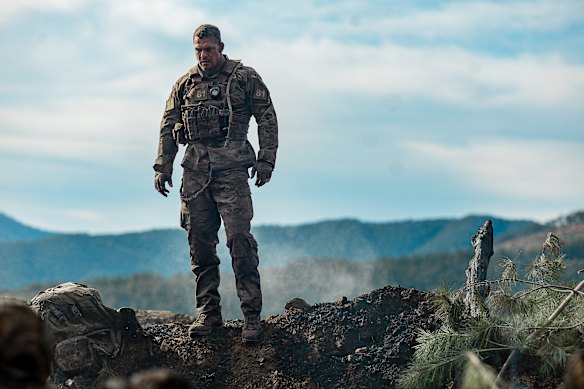
Alan Ritchson as 81 in War Machine.BEN KING/NETFLIX
The Australian-made sci-fi action movie War Machine is a raging success by almost any standard. It was the number one movie globally on Netflix for two weeks, has been in the top 10 in 93 countries, number one in 87 of them including the United States, Australia and Canada, and has chalked up more than 118 million views in its first five weeks on the platform.
For context, that’s 20 million more views than Guillermo del Toro’s big-budget triple Oscar-winning Frankenstein managed in its first eight weeks last year.
But in one regard, the interplanetary war movie was a dismal failure. It tanked at the box office.
War Machine had a reported budget of around $113 million ($US80 million), about $73 million of which was spent in Australia. But at local cinemas, it took just $82,000 in five weeks. In its final week on release, it earned just $180 in ticket sales.
But behind those stark figures there’s a far more complex story, one in which that cinema release unlocked millions of dollars in government incentives, and one in which a loophole transforms that box office narrative from one of abject failure to a massive windfall.
Though it has an American star (Reacher’s Alan Ritchson) and centres on an American military training program, War Machine is very much an Australian movie.
Writer-director Patrick Hughes is Australian, his co-writer James Beaufort is Australian, several of the producers (including Wolf Creek’s Greg McLean) are Australian, and co-star Jai Courtney is Australian. And because it ticks the boxes of having Australians in four of the key creative roles (writer, director, producer, lead actor), it qualifies for a 40 per cent rebate on Australian expenditure through the producer offset, which is administered by Screen Australia on behalf of the Tax Office.
But there’s a rub. To access that 40 per cent rebate, the film needs a cinema release. Had it been classified as a movie made for streaming or television, it would qualify only for a 30 per cent rebate.
That’s no small difference. In fact, the extra 10 per cent on the Australian spend of $73 million amounts to $7.3 million returning to Lionsgate, the Hollywood studio that financed the film.
Director and co-writer Patrick Hughes on the set of the film.BEN KING/NETFLIX
And that’s the true value of its five-week cinema run in Australia – $7.3 million, rather than the $82,000 in ticket sales.
Typically, only about one-third of box office would flow back to the studio, with the distributor (Roadshow) and exhibitors (the cinemas) taking the rest. By contrast, the full value of the rebate goes to the producers.
Back in 2021, the Coalition government was determined to simplify the tax rebates offered to the screen production sector, with a flat 30 per cent regardless of whether content was made locally or by Hollywood, for the big screen or small.
While simplicity and a level playing field were the great attractions of that plan, there were legitimate fears that Australian feature films would be unfairly punished. And at the 11th hour, after meeting with a delegation that included actors Bryan Brown, Simon Baker, Justine Clarke and Marta Dusseldorp, the government backed down. Australian feature films made for the cinema would still get a 40 per cent rebate.
There is nothing illegal about the producers of War Machine accessing the 40 per cent producer offset. That is how most movies are financed in Australia. But it does highlight an unintended consequence of the distinction between movies made for cinemas and other platforms, most notably streaming – and the incentive producers might have for putting a movie into cinemas even when they have no real interest in how it performs there.
Actor Jai Courtney was crucial to the film qualifying as Australian. BEN KING/NETFLIX
To be clear, War Machine was originally developed with a cinema release firmly in mind. Patrick Hughes came up with the idea in 2017, it was first announced in November 2021, and in January 2022 he and production partners Beaufort and McLean launched their Melbourne-based production company Huge Film, with ambitions to make big-budget action movies for the global stage. War Machine was on the slate, along with The Raid, a remake of Welsh director Gareth Evans’ 2011 Thailand-set heist movie that Hughes has been trying to get off the ground at least since I lunched with him back in 2014.
“Our intention was to make it theatrically,” Lionsgate executive Erin Westerman told The Wrap last month, of War Machine. “And then when our sales team went out to start conversations with the international buyers, the streaming market was just so frothy that … we all chose together to go to Netflix.”
That deal was in place by September 2024, when the start of filming in Victoria’s High Country (where Hughes made his debut feature, the modern-day Western Red Hill, in 2010) and at Docklands Studios Melbourne was announced (the production also shot for a couple of weeks in New Zealand).
“War Machine will be distributed theatrically in Australia by Roadshow Films and released internationally by Netflix,” the official release stated.
Australia is, in fact, the only country in the world where War Machine has had any kind of cinema release. But even here, it appears to have been something of an afterthought.
Though Roadshow’s release schedule issued on January 7 included titles up to the end of the year, War Machine was not listed. But just five weeks later it was in cinemas.
The film was released on just 52 screens, a staggeringly small number for a movie with blockbuster ambitions. There was nothing much by way of advertising and promotion.
On February 23, Netflix began promoting the film on its social media channels, with a streaming date of March 6.
Clearly, no one had much incentive to make War Machine work at the box office. And unsurprisingly, it didn’t.
And yet, that $82,000, five-week run might just be the best return the film’s producers could ever have hoped for.
For decades, the film industry has operated around a single moment.
The greenlight.
A script is developed. Talent is attached. A package is built. Then it goes into a room where someone decides whether the film gets made. That idea still exists. It just doesn’t carry the same weight.
Because the real decision is happening earlier.
Long before a distributor reads the script or a financier looks at the numbers, there are already signals in the market. Audience response to certain concepts. Creators building followings. Platforms backing specific types of projects.
By the time something reaches a formal greenlight conversation, much of the uncertainty has already been exposed. The meeting doesn’t create belief. It tests whether it’s already there.
You can see it in what moves. A horror film with a clear hook and defined audience will often move faster than a well-written drama with no obvious entry point. The pathway is easier to recognise.
The same applies to creator-led projects. When someone arrives with an audience, they’re not just bringing visibility. They’re bringing proof. We’re already seeing this play out with creator-led films like Iron Lung, where the audience existed before the film did. That shifts the risk calculation. The project is no longer being assessed in a vacuum.
At the higher end, familiar IP continues to dominate for the same reason. Recognition does part of the work before the film even exists.
The industry used to take more swings. Now it looks for evidence. That shift changes where leverage sits. It’s not held only by the person writing the cheque. It sits with whoever can show why the film will be watched.
That doesn’t require a large audience upfront. It does require a visible path to one. Without that, projects become difficult to finance, difficult to sell, and difficult to position. The problem isn’t quality. It’s the absence of something the market can respond to.
This is where many films run into trouble. They’re developed in isolation, then introduced late. At that point, the industry is being asked to commit without enough to anchor the decision.
The projects that move tend to arrive differently. A concept that travels. A piece of IP that carries recognition. A creator or community already paying attention. The form varies. The effect doesn’t. The film shows up with momentum.
What replaces the traditional greenlight isn’t a single decision. It’s a sequence of confirmations that happen earlier and compound. By the time someone formally says yes, the direction is already set.
Risk hasn’t disappeared. It’s just being judged differently.
The question is less about whether the film works on the page, and more about whether there’s a clear reason for it to exist in the market. That’s a harder standard. It also makes the outcome easier to read. Because once that signal is there, the rest of the system tends to follow. And by then, the greenlight isn’t the starting point.
Australia’s international coproduction treaties are in urgent need of revamping to better reflect the current screen industry, according to Screen Producers Australia (SPA).
Matthew Deaner
Speaking at the Australian International Documentary Conference (AIDC) in Melbourne today, SPA chief Matthew Deaner said that while progress on regulatory reform has been “encouraging” over the past year, “structural settings must continue to evolve if Australian documentary is to thrive in 2026 and beyond.”
He has called for continued reform to ensure the government’s National Cultural Policy’s commitment to genres including documentary is fully realised.
Updating of coproduction treaties is a key area that needs work, he said. “For example, the formal coproduction arrangement with Canada is over 20 years old and reflects realities about screen production that no longer exist. Meanwhile, our attempts for renewed coproduction arrangements with the UK have not progressed since announcements made in 2021.”
SPA took a delegation of around 20 Australian producers to the Prime Time conference in Canada in late January in a bid to update the countries’ coproduction treaty.
Deaner said that the need for media reform was essential, even with clear wins such as the introduction of streaming content obligations. These will now be tested by whether the new streaming framework “translates into genuine commissioning activity for independent producers, including documentary makers.”
“Whilst the intent of the reform is clear, its impact will depend on how it is delivered in practice, especially in the absence of a required genre mix,” he claimed.
Deaner said SPA remained engaged to ensure the regulatory settings result in tangible outcomes for documentary production businesses.
Regarding the documentary reform agenda, he said that lifting the 65-hour cap on doc access to the Producer Offset remained a priority.
“The cap is an outdated constraint that limits the ability of documentary producers to grow sustainable slates and respond to audience demand. If we are serious about sector sustainability, documentary must be treated equitably within our screen incentives framework.”
He added that this should also include access to the Post, Digital and Visual Effects Offset for feature documentaries, “without which Australia will continue to lose this work to other territories.”
Deaner noted that doc makers rely on a variety of channels to distribute their projects: “Aligning the treatment of TV and feature films under the offset system would relieve unnecessary financial strain in documentary production,” he said.
She hasn’t been in the job long – “three months and one week”, to be precise – but Amanda Duthie, the head of content at Netflix Australia and New Zealand, has been busy.
“We have literally been in hundreds of meetings with producers,” she says. “We wanted to open the doors and windows and say, ‘Come and talk to us about your projects, come and get to know us’, because people might know us together or separately, but they’ve never seen that whole team at Netflix, it’s a brand new thing. It’s a curiosity. And it’s been so pleasing that the opportunity to come and pitch to Netflix has been really, really welcomed by the sector.”
The “we” encompasses her second, content director Katherine Slattery, who was formerly at Matchbox Pictures, the production company that this week announced it was folding after 18 years and a string of hit shows (The Slap, Glitch, Hungry Ghosts, Safe Harbour and the recently released Dog Park among them).
Duthie doesn’t say it, but her invitation to the nation’s filmmakers to come and pitch their wares stands in stark contrast to the way the streamer was perceived under her predecessor, Que Minh Luu, who departed suddenly last April. Industry sources told this masthead last year that relations between the streamer and the production sector had become so strained that many filmmakers had simply decided there was no point in approaching Netflix Australia with their pitches.
Duthie was poached from Stan, where she had headed the Originals team for five years.Steven Siewert
But at a slick showcase in Sydney on Tuesday before a few hundred key industry players, Duthie made her first public foray since leaving rival streamer Stan last August.
She presented a slate of Australian shows, along with some international productions made here, that will soon drop on the service. Among them: the third and final season of Heartbreak High (“At least until the sequel,” she joked, veering off script, much to the consternation of her minders); the series adaptation of My Brilliant Career; the high-octane action movies War Machine and Apex and surf drama Breakers; the animated Stranger Things spin-off Tales From ’85; the reality competition Wonka (set inside a Gold Coast set modelled on the famous fictional chocolate factory); and Allen, a live-action movie from Ludo, the Brisbane studio behind the world’s most streamed show last year, Bluey.
Duthie readily admits she can take no direct credit for this line-up, as it was all under way long before she arrived (though insiders say she has been very involved in the latter stages of at least some of it).
Philippa Northeast and Kate Mulvaney in the upcoming My Brilliant Career series. Netflix
“We’re custodians of those new Netflix original shows, and they’re all exceptional,” she says. “It has been a privilege to take the baton and run with it.”
It’s clear, though, that she is itching to stamp her identity on Netflix’s local slate. As a former executive at the ABC and SBS, and head of Originals at Stan for five years, she’s used to calling the shots rather than riding shotgun.
She doesn’t know precisely when “we’ll come back out and announce what we’re cooking up for ’27”, she says, but she’s hoping it will be “at some point this year”.
Duthie comes to the job at an interesting juncture. Netflix has made an offer to buy Warner Bros, a massive deal that says much about the maturity of the streaming business (growth through acquisition of rivals rather than customers is now the strategy, it seems). And locally, quotas are now in place for the first time.
Under the Australian content obligation, all streaming services with more than 1 million subscribers will have to fund, produce and screen Australian content (free-to-air and cable broadcasters have long been bound by similar laws, but before January 1, streamers were exempt). The production sector had long argued for such obligations – similar to those in place in Canada and much of Europe – in the belief it would protect against boom-and-bust cycles, and in the hope it would provide a significant uptick in investment.
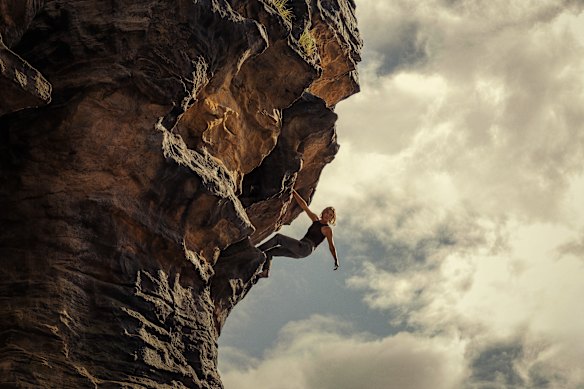
Charlize Theron hangs off the side of a cliff in the Australian-shot thriller Apex.Kane Skennar/Netflix
The jury is out on the latter, though. And with the ACMA having quietly extended the deadline for streamers – from March to the end of the year– to choose between a 10 per cent levy on revenue or a 7.5 per cent levy on expenditure (because the latter is so difficult to calculate), exactly how much money will be in the pot is still unclear.
As far as Duthie is concerned, though, “it’s business as usual” for Netflix. Whichever model the streamer ultimately chooses, insiders are convinced the company is already meeting its obligation, and then some.
And that means for the hundreds of producers who have already met with the new Netflix team, and all those still waiting for their turn, disappointment is very likely just around the corner. But for the lucky few, it could be the deal of a lifetime … literally.
“I have been aware of some projects for 20 years, and maybe only now they’ll come to light,” Duthie says. “That is not a dog whistle to something I’m about to announce, but what I’m saying is, you can track projects – whether it’s that book, or that play, or that conversation you had at a party 15 years ago. You recall those conversations, and you go, ‘Whatever happened to…?’”
Do you call those people?
“Sometimes, yeah.”
So, don’t give up hope yet, all you producers?
“Exactly, exactly. It’s a long game. Yeah.”
As for the sort of content she’s after, well, who knows.
“Every meeting is like unpacking a new present,” she says. “You don’t know what you’re going to find. Are you going to find an Apple Cider Vinegar, a Boy Swallows Universe, another Heartbreak High, another My Brilliant Career? You walk in with open hearts and minds, keen to hear what is that new thing that you’ve never even imagined. Someone tells you and you go, ‘Oh, yeah. Oh my god, that is it. That is amazing. Come on, let’s talk about it. That’s something’.”
Duthie won’t get to commission anywhere near as many shows at Netflix as she did at Stan. But because Netflix buys shows outright rather than looking for international co-financiers (as Stan, the ABC and most other broadcasters do), she’s convinced she’s in a position to make the most purely Australian shows of her career.
“When you’re looking at that international financing model, you [have to ask] do you need an English uncle [in the show, to make it palatable to an English broadcaster], do you need a French cousin, what are those things that might be required, on screen and off, to facilitate a locked-in international finance plan?
“The privilege, the honour, the complete and utter joy of working at Netflix is you don’t have to worry about that. It’s liberating because we don’t have to wait for validation from the international market. [We can say] ‘This is what Australians have always wanted’.”
But surely Netflix is looking for shows that will travel internationally?
“Our brief is pretty clear,” she says. “It’s drenched in that desire and that need to find stories that are local, that are going to resonate for local audiences.
“If the global glow comes, that is great,” she says. “But it’s local audiences first.”
Phoebe HartAssociate Professor, Film Screen & Animation, Queensland University of Technology
Members of the Australian screen industry have been shocked to learn one of the nation’s most successful and prolific production companies, Matchbox Pictures – and its subsidiary Tony Ayres Productions – will shut their doors this week.
Matchbox was closed by its parent company, Universal International Studios, and the closure has resulted in the loss of 30 full-time equivalent positions.
The reasons cited by Universal are vague. According to a media release, “extensive evaluation of the business and the broader production landscape” influenced the decision. The global production arm of NBCUniversal has said it will take on new business and talent on a case-by-case basis from here on.
This is crushing news for the local screen industry, which finds itself increasingly beholden to decisions made by overseas corporations.
18 years in the making
Matchbox Pictures was founded in 2008 by screen industry stalwarts Tony Ayres, Penny Chapman, Helen Bowden, Michael McMahon and Helen Panckhurst.
Together, they have made some of Australia’s most iconic television series including The Slap (2011). This series changed how the world perceived Australian drama, as an innovative, gritty morality play remade in the United States.
Read news powered by real experts.
The Matchbox team was also responsible for other critically acclaimed and AACTA Award winning projects, such as Secret City (2016–19), Stateless (2020) and Glitch (2015–19), among others.
More recently, they gave us The Survivors (2025), the best performing local TV drama on Netflix in 2025.
As one of the bigger employers of local talent and crew, one might ask how this happened.
Acquisition by Universal
In 2011, Matchbox sold a majority stake to NBCUniversal. At the time it seemed like a shrewd move. It meant the company, which is headquartered in Sydney with offices in Melbourne and Singapore, would get better access to international markets, stronger global distribution channels, and the ability to upscale productions.
However, it also meant Matchbox was subject to global winds of change, rather than local breezes. And the wind is blowing. Comcast, which owns NBCUniversal, is in downturn, reporting a significant revenue decline and job cuts in 2025. This means they’re probably eager to lighten the load.
Another reason is the changing nature of streaming content regulation in Australia. The Labor government’s move last year towards regulating local content quotas for media giants such as Netflix was a big win for advocates.
But it also introduces uncertainty, which means international companies may choose to withdraw from the region instead of investing in Australian content.
There is no law requiring overseas content providers to maintain a presence in Australia. Although Universal has said it will continue to do business here, the new environment arguably makes maintaining a fully-staffed production arm less attractive.
The Matchbox closure is the first clear example of this.
So, where does the recent closure leave the local industry? For one thing, we’re likely to see reduced capacity to nurture in-depth, large-scale local productions.
It also makes the future uncertain for up-and-coming practitioners, especially those from diverse backgrounds, which Matchbox was well-known for championing. The shutdown means the loss of salaried jobs and a consistent commissioning pipeline.
Matchbox was also a steady source of contract work for freelancers – whose situation is now even more precarious.
It’s possible the closure will lead to more opportunities for mid-size producers pitching their projects to broadcasters, studios and streaming platforms – especially with the introduction of new streaming quotas for local content.
There are some left in Australia that may step in to fill the gap: Hoodlum Entertainment, CJZ, Curio Pictures, Endemol Shine Australia, See-Saw Film, Beyond International and Goalpost Pictures spring to mind.
Then again, some of these are also owned by overseas interests. It’s a “watch this space” situation.
Hamnet began its journey to the screen when Hera Pictures’ Liza Marshall optioned Maggie O’Farrell’s 2020 novel of the same name, then bringing in Neal Street Productions’ Pippa Harris — a former colleague — to develop the feature together. The film was set up at Focus Features, which released in North America, with Universal Pictures handling internationally.
Chloé Zhao directs, co-writing with O’Farrell, and the producer team is rounded out by Zhao’s partner at Book of Shadows Nicolas Gonda, Amblin’s Steven Spielberg and Neal Street’s Sam Mendes. At press time, Hamnet’s worldwide box office stood at $63.4m, including a powerful $21.2m (£15.8m) in the UK and Ireland — surpassing fellow awards contenders One Battle After Another and Marty Supreme in the territory. Hamnet, which is nominated for eight Oscars and 11 Baftas, is on course to overtake Sinners ($22.3m/£16.4m) in the UK and Ireland, becoming this season’s highest-grossing Bafta best film nominee in the territory.
Marshall launched Hera Pictures in 2017 after heading Scott Free Productions UK and working at Channel 4 as head of drama. Her recent credits include 2023 film The End We Start From, starring Jodie Comer, and ITV’s 2025 ratings hit I Fought The Law, starring Sheridan Smith. Hera is in pre-production on The Return Of Stanley Atwell, written and directed by Brian Welsh, and starring Nicholas Galitzine and Marisa Abela.
Harris launched Neal Street with Mendes and Caro Newling in 2003. The banner’s feature credits include Mendes’s 1917, Away We Go, Empire Of Light, Revolutionary Road and Jarhead. TV hits include Call The Midwife, Penny Dreadful and Britannia. Coming up is an adaptation of The Magic Faraway Tree, and Mendes’s ambitious, Sony-backed four-film big-screen event about The Beatles.
Screen International brought together Marshall and Harris to discuss the journey to the screen of Hamnet — which explores the grief of William Shakespeare (Paul Mescal) and his wife Agnes (Jessie Buckley) following the death of their son Hamnet (Jacobi Jupe) — as well as the current landscape for UK independent film and TV production.
Screen: Liza, this started with you optioning the book.
Liza Marshall: It was sent to me by Maggie’s agent in October 2019 [before publication], and I completely fell in love with it. So I got on a Zoom with Maggie, and she let me buy the rights. I liked that it has Agnes at the centre of the narrative — that Maggie rescued her from the shadows of history — and the way it imagines where Shakespeare would have got some of his inspiration. The story is unbearably sad, but the way Shakespeare transforms that into the play [Hamlet], and that there is hope at the end of the book — I just felt that narrative would work.
Pippa, how did you both team up?
Pippa Harris: We’ve known each other for years. We met in our twenties at Carlton, part of ITV, and worked together closely for a couple of years.
Marshall: It was on [1990s soap opera] London Bridge. I was script editor, you were executive producer.
Harris: I read the book and the agent said Liza had the rights, so I thought it would be worth [getting in touch]. You’d already had a few people like me contact you. Somebody had said, “We’ll set this up for TV,” and I think you and Maggie were tempted. Then we started talking about a film…
Marshall: …and imagining it on a bigger scale.
Source: Agata Grzybowska
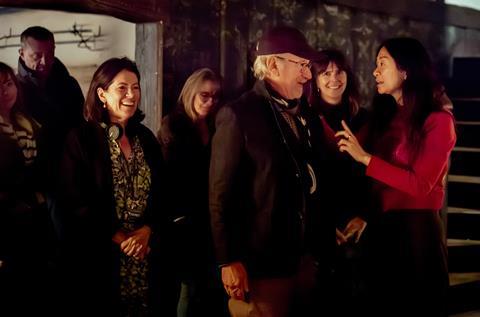
Pippa Harris (left) with Steven Spielberg, Liza Marshall and director Chloe Zhao on the set of ‘Hamnet’
How did Amblin and Steven Spielberg get involved?
Harris: Sam and I did 1917 with Amblin. When we first got together with Liza, they were still funding films. Their model has changed now — they’ve gone back to their roots [as producers]. But at the time, we thought, “Great, that’s a one-stop shop.” And of course, Steven’s an incredible collaborator.
Marshall: Chloé was the first person we thought of to direct. We both loved The Rider, particularly. And there’s something about the way she photographs nature. Also, someone who’s not as steeped in Shakespeare as we are as British people — to get that different perspective.
Harris: We started talking to Chloé through her people. Then, by chance, I was in Telluride in 2022 at the same time as Chloé, and met her there.
Marshall: The strike and various things delayed it. We got a draft [script from Zhao and O’Farrell]. It then went pretty quickly, because Paul had to have an out date to do press for Gladiator.
Harris: Also, Steven was able to take it to Focus. If anyone can get a greenlight, it’s Steven Spielberg. He was able to have those top-level conversations, so that process was very smooth compared to other films we’ve worked on.
What is the budget for the film?
Harris: Roughly $30m (£22m).
Was it fully financed by Focus?
Harris: Yes. It was great. There is an immense relief when you get someone like Focus [on board].
Five of you produced the film. How would you describe the division of responsibilities?
Marshall: Pippa, Nic and I were boots on the ground in terms of being there through pre-production, the recces and on set. We shared it so there was always somebody there for Chloé, keeping an eye on it all.
Harris: Sam and Steven were there as sounding boards. In pre-production, Chloé relied on Steven quite a bit, particularly in the casting of the kids. She had tapes of the children, and obviously if Steven says, “That’s a great piece of casting,” you think, “Oh, probably okay then.”
Marshall: He gave us brilliant pointers about how to do improvisational scenes with the kids, and not to get them to learn the lines. Because then it becomes a bit more like a school play performance. [You want them to] react in the moment.
Harris: In post, Sam, Liza and Maggie and I saw the first cut together. Because Sam’s another director, he comes at it slightly differently to Maggie, Liza and me. He was able to talk to Chloé, in her own language, about its very specific moments and to give very specific notes that she found really helpful. Afterwards, she said Steven was similarly helpful.
Marshall: Everybody was doing quite distinct but intermeshed things. And obviously Nic and Chloé have their company together, and they’re incredibly close. Nic’s just such a lovely man. We didn’t really know him before this collaboration, but he became an essential part of the team.
Harris: Liza brought on board a brilliant EP called Laurie Borg, who she had worked with before. He was instrumental as well, just in terms of the day in, day out. Are we hitting the schedule? How many people are coming for lunch, all that stuff.
Marshall: His calm energy was perfect with Chloé, because it created that space where she could experiment and try things out.
And it is an emotional story to navigate on set too.
Marshall: At the end of each week Chloé put on a disco tune to get the cast and the crew to dance. Particularly for the children, it means their memory is of the dancing, not pretending to die. After Hamnet’s death, Jacobi asked for a bonus dance track, and chose ‘Stayin’ Alive’. He came up from the sheet [his death shroud] and they were all dancing around. That helped change the atmosphere.
Harris: Chloé also brought her own layer of mysticism to the process, and has talked a lot about [using] dream workshops. That wasn’t something I’d ever come across before. Initially, when you’re looking at every penny of the budget, you’re thinking, “Really, we’re paying for the dream coach?” Then as it went along, you realise how integral Kim [Gillingham], the dream coach, was to the process.
Source: Focus Features
Hamnet
Why do you think Hamnet has blown up at the box office?
Marshall: I think it’s connecting because we’re living in such bleak times. Everybody is going to sit in a darkened room with strangers, and then come out and feel like it’s a cathartic process that they’ve been through. There are these videos on TikTok, before Hamnet and after Hamnet — people have got their make-up on, and then they’ve got all the make-up coming down their face.
Harris: Although it’s a very sad film at times, people come out of it feeling that it’s somehow been life-affirming. Particularly when so many other films’ pivotal moments are all about violence and people being shot.
Does Hamnet tell us anything about the state of the UK film industry at the moment?
Harris: The film industry is in a strange place because it feels, on the one hand, as though funding for massive films — like Sinners or even our own Beatles project — is relatively attainable. If you’re making smaller-budgeted films that the UK has excelled at, like The Ballad Of Wallis Island and Pillion, they’re not easy to make, but there are funders for those films. What’s become increasingly difficult is mid-range — anything that sits at £10m-£40m [$14m-$54m]. The American studios have retrenched a bit, so Searchlight, Focus and Sony Classics are maybe not doing quite so many.
Liza and I made our careers in television, and we still do TV as production entities. It’s the television that keeps you going — it’s virtually impossible to run a UK company simply making films.
Is the indie film tax credit helping?
Harris: That is slightly lower, but it’s definitely helping. And there is a will in government to find ways of supporting film, and looking at whether the apprenticeship levy can be used more effectively for film and television — it’s difficult to use that at the moment, because it’s not geared towards the freelance market. And so many people working in film are freelancers.
What other government interventions would you like to see?
Harris: For film, the thing that the government should do is simply to keep the tax credit as it is — the stability of the UK film tax credit has been transformational. It’s been 25 years now, and it has transformed the industry. The government has been looking at possibly changing the high-end TV tax credit and giving a boost to productions like Adolescence, or slightly lower-budget productions, and that would be helpful — because after all, witness the two of us. TV is the training ground for writers, directors, everything.
Marshall: UK talent comes through television generally, not always.
How about financing films with a female director, like Hamnet? Is that getting easier?
Harris: If you look at the top films in 2025, just 8% have been directed by women [according to the USC’s Annenberg Inclusion Initiative]. So there is still a massive problem. There’s an element of studio heads — who are mainly men — being nervous about trusting women with bigger-budget films, even though there are ample examples of women who’ve directed hugely successful, profitable movies.
I’ve never had conversations where people have said, “You can’t have a woman direct this film.” It doesn’t work like that. It’s more insidious in that when you’re looking at [director] shortlists, you suddenly think, “Well, there don’t seem to be many, or any, women on this shortlist.”
Liza, you launched The Return Of Stanley Atwell at Cannes last year, with pre-sales.
Marshall: Protagonist Pictures made some good sales there, and then we’ve partnered with John Gore Studios, and they’re great. So we’ve got a budget. It’s never enough money, trying to make a film. It’s always rocky.
Pippa, why is The Beatles not coming out until 2028?
Harris: The plan is that, potentially, they’ll all be available in cinemas at the same time. So if you want to binge, watching all four of them, you’ll be able to do that. But we won’t finish filming until the end of this year.